
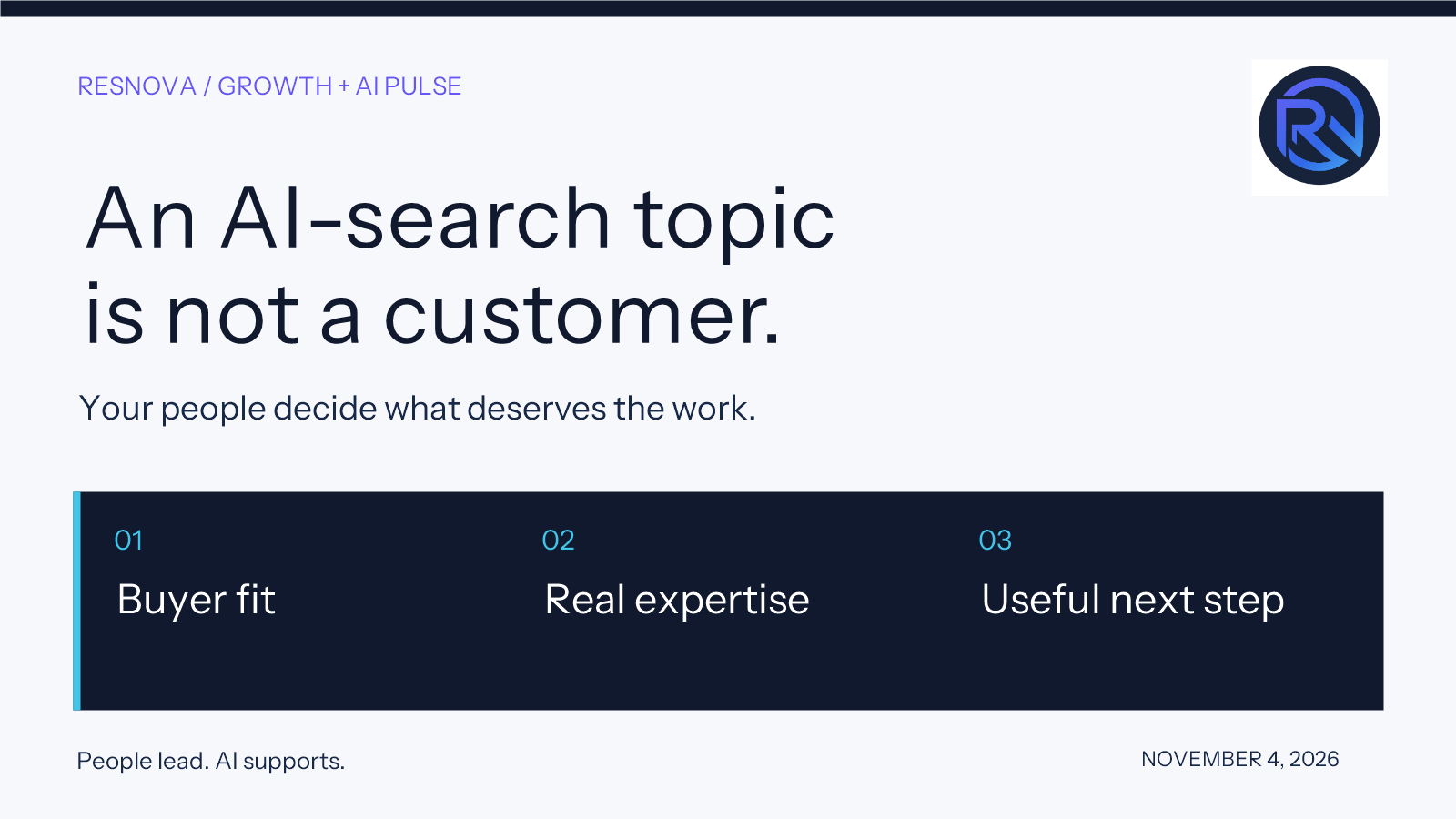
The short answer: Choose AI-search topics the same way you choose other marketing work: start with a customer your business can serve, identify a decision they need help making, and put the right people behind the answer. A suggested query is a research lead. It is not an instruction to publish.
Another list of topics. Still no clear priority.
An owner asks why the website is not bringing in the right inquiries. The response is a calendar of twenty new articles. But nobody has explained who those articles are for, whether the business wants that work, or what happens when someone gets in touch.
More content might help. It might also keep a team busy while the important gaps stay open. The leadership job is to decide which problem deserves attention and coordinate the people who can solve it.
What Bing’s new report can tell you
Bing announced Topics Portfolio, a beta feature within Webmaster Tools’ AI Performance report, on October 13. It groups queries associated with a site’s presence into topics and surfaces opportunity queries where other sites appear. Its size and competition figures are approximate; opportunity citation volumes are ranges.
Availability depends on sufficient data. Bing also warns that automated topic labels can be imperfect and competitor-brand queries may appear as opportunities. Use the report as a starting point for investigation. A missing topic does not prove there is no demand, and a large topic does not establish demand for your particular service. This is Bing evidence, not proof of visibility in every AI product. See Bing’s announcement and limitations.
Put three questions between the report and the content calendar
1. Would we actually want this customer?
Read the query in full, not just its topic label. Does it describe the kind of customer, location, application and purchase your business serves? Ask sales what a useful inquiry looks like. Where possible, compare the wording with actual questions from prospects, with private details removed.
For example, a commercial equipment distributor may want to help an operations manager compare servicing requirements. A broadly related consumer repair question may attract people the distributor cannot help. That is an illustrative distinction, not a claim about a client or a measured search trend. The larger audience is not automatically the better audience.
2. Can our people give a useful, supportable answer?
Find the person who knows the answer: a technical specialist, service lead, salesperson or owner. Ask what buyers commonly misunderstand, which tradeoffs matter, and where the answer depends on the situation. Those details are the substance of the page.
If the team cannot support a statement, leave it out or investigate it. Do not invent a case study, promise a saving, or turn an uncertain recommendation into a confident headline. AI can help organize approved notes. People supply the experience, check the facts and remain accountable for the advice.
3. What would help this buyer move forward?
The next step should fit the decision. Someone evaluating compatibility may need a clear list of information to bring to a specialist. Someone comparing service providers may need to understand scope, responsibilities and how an initial conversation works.
Check the existing website before adding a page. A short, specific improvement to a service page may answer the question better than a separate article. Give that page a relevant internal link and a clear contact route. Do not multiply near-identical pages for slight variations of the same question.
A practical decision: improve, investigate or leave alone
Improve now when the buyer fits, the team can substantiate the answer and an existing page has a clear gap. Assign a marketing owner and an expert reviewer, then make the smallest useful change.
Investigate when the audience seems relevant but the need is unclear. Bring the question to the next sales or service conversation before commissioning content. Record what would change the decision.
Leave alone when the query is outside the service, chiefly about another brand, or would require claims the business cannot support. Choosing not to pursue a topic is a valid marketing decision.
What this looks like in a weekly working session
Bring one candidate query, the relevant public page and a real buyer question to a short conversation between marketing and the person closest to the customer. Agree on one answer to improve, one reviewer and one next step for the reader. Publish after checking the facts, phone layout and contact path. Keep the previous version so an error can be reversed.
Then look for useful movement: relevant visits, inquiries that match the service, and conversations progressing to a real opportunity. Keep citations, measured referrals and a prospect’s own explanation of how they found you separate. Our AI-search measurement guide explains that distinction in more detail. Neither a citation nor a completed article guarantees a lead.
Your team should not have to guess what matters
ResNova provides fractional marketing leadership for businesses that need someone to set priorities and carry them through with the people doing the work. That includes deciding what deserves a place on the website, connecting it to sales and checking whether it helps the right customers.
If your website, content and follow-up are being managed separately, start with our Marketing System Assessment or book a conversation. We can help identify where clearer direction would make the work more useful.
Sources and further reading
Put the framework to work
Find the constraint in your growth system.
ResNova can diagnose the current path, set the priorities and build the strategy, execution and infrastructure required to improve it.
Book a Growth Strategy Call ↗