
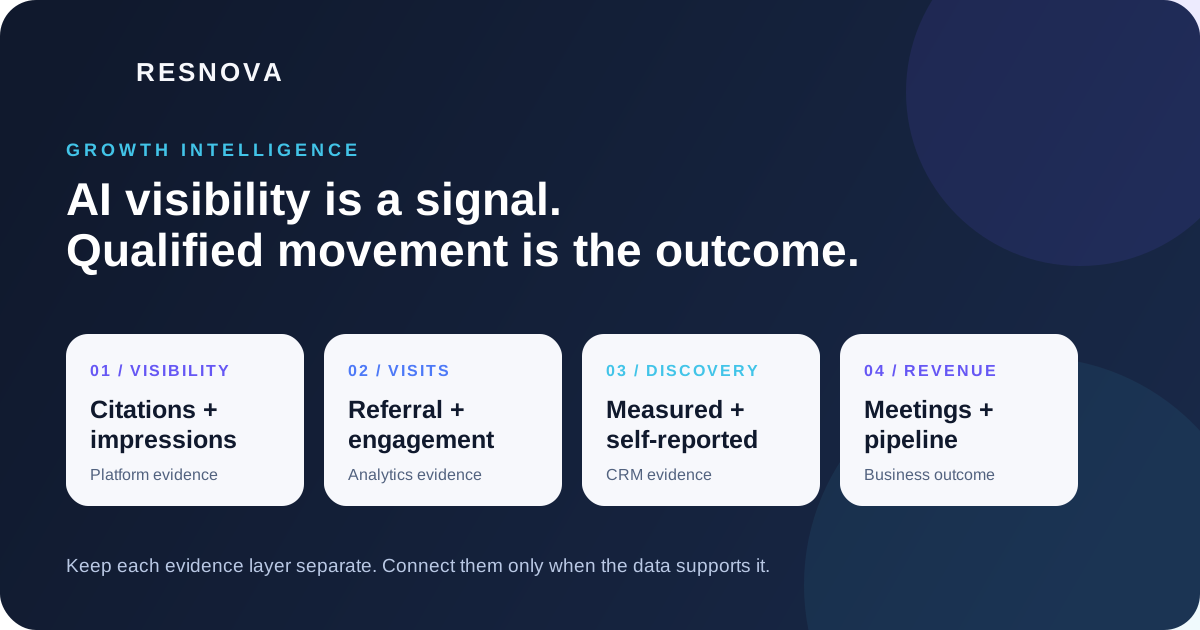
The short answer: Measure AI search in four layers: visibility, attributable visits, self-reported discovery and qualified revenue outcomes. Keep those layers separate. A citation is evidence that a platform used a page; a referral is evidence that someone reached the website; a self-reported source is evidence of what the buyer remembers; and a meeting, opportunity or customer is the commercial result. None of those signals should be substituted for another.
AI discovery is now visible in more reporting systems, but the metrics describe different parts of the buyer journey. Google Search Console, Bing Webmaster Tools, Google Analytics and HubSpot can each contribute evidence. The useful operating question is not simply whether the company appeared in an AI answer. It is whether the right buyer found a credible answer and moved toward a qualified conversation.
What should the measurement model include?
Impressions, citations, pages and topics.
Measured referral and landing-page behavior.
The buyer's optional self-reported source.
Qualified conversations, pipeline and customers.
Visibility shows whether a search or AI system is surfacing the company's content. Visits show whether a person clicked through. Discovery adds the buyer's own explanation when the referrer is unavailable or incomplete. Revenue shows whether the interaction became commercially meaningful.
Report the layers together, but never collapse them into a single inflated number. A dashboard that labels citations as leads or direct traffic as AI traffic creates false certainty.
What do Google and Bing actually report?
Google's Search Generative AI reporting provides dedicated visibility views for generative features while keeping that activity connected to the broader Search performance picture. Google also states that its core SEO guidance still applies to AI Overviews and AI Mode: eligible, indexed, people-first pages remain the foundation.
Bing's AI Performance report focuses on visible citation activity across supported AI experiences. It can show cited pages, citation trends and grouped grounding queries. Bing explicitly distinguishes citations from rankings, traffic and engagement, and describes the data as aggregated and sampled. That makes the report useful for topic and content decisions, not as a substitute for pipeline reporting.
Use these tools to answer questions such as: Which pages are being selected? Which commercial topics appear? Is the information accurate and current? Where does ResNova need a clearer definition, stronger evidence or a better answer?
How should AI referral traffic be handled in analytics?
Google Analytics now includes an AI Assistant channel for visits from sources such as ChatGPT, Gemini, Copilot and other recognized assistants. Google places AI Overviews and AI Mode inside Organic Search rather than the AI Assistant channel. This means a single top-line AI channel does not represent every AI-assisted visit.
Preserve the raw source and medium alongside any normalized channel label. Review landing pages, engaged sessions and completed conversion events, but exclude internal and test traffic before interpreting performance. When the referrer is missing, classify the visit as unknown or direct according to the platform's rules; do not infer that it came from AI.
Why should CRM source and self-reported discovery remain separate?
HubSpot distinguishes Original Traffic Source from Latest Traffic Source and now includes AI Referrals as a source category. The original source describes the first known web interaction; the latest source can change as the buyer returns through another channel. Both are useful because B2B buying rarely happens in one visit.
An optional “How did you hear about us?” field captures a different kind of evidence. A buyer may remember that ChatGPT introduced the company even when the eventual form submission appears as direct, organic search or another tracked source. That response should be stored as self-reported discovery, not used to overwrite measured first-touch or latest-touch data.
For each qualified inquiry, preserve four fields when available: measured first touch, measured latest touch, self-reported discovery and the specific landing page or offer. If one field is unavailable, keep it unavailable.
Which outcomes should leadership review?
- AI visibility: impressions or citations by platform, topic and cited page.
- Website response: identifiable AI referrals, engaged sessions, assessment starts and completed forms.
- CRM evidence: AI-referral contacts, self-reported AI discovery and source combinations.
- Qualification: inquiries that match the target buyer, need and service scope.
- Commercial movement: meetings, opportunities, pipeline and customers influenced by the journey.
Keep verified referrals, self-reported discovery and inference in separate categories. A useful monthly review can then show four states: both measured and self-reported, measured only, self-reported only and unknown.
What should a growing company do in the next 30 days?
- Confirm technical eligibility: verify indexability, canonicals, sitemap coverage and crawler access for the platforms the business intends to support.
- Define the source model: document the AI domains and channel rules used by analytics and CRM systems.
- Add low-friction discovery evidence: make self-reported discovery optional and keep it separate from measured attribution.
- Test one real path: follow an inquiry from landing page to form, CRM record, owner, meeting and opportunity.
- Build one leadership view: report visibility, visits, discovery and revenue outcomes with dates and source freshness.
- Improve the cited answer: update the page when the platform evidence reveals an accuracy, depth, freshness or conversion gap.
The ResNova point of view
AI search creates a new layer of buyer discovery, but it does not change the standard for growth decisions. Visibility is useful only when it helps the business become easier to understand, easier to trust and easier to buy from. The measurement system should preserve uncertainty while making the next action obvious.
ResNova connects AI search visibility, revenue measurement and CRM handoffs so leadership can see where discovery becomes qualified movement. Start with the Marketing System Assessment to identify the first constraint.
Frequently asked questions
Direct answers for the next decision.
Is an AI citation the same as a website visit?
No. A citation shows that a page was visibly referenced in an AI-generated answer on the reporting platform. It does not prove that a person clicked, visited the site or became a lead.
Can direct traffic be counted as AI traffic?
No. Direct traffic means the analytics system did not receive a usable referral source. A buyer may later self-report AI discovery, but that evidence should remain separate from the measured source.
Should self-reported discovery replace first-touch attribution?
No. Store the buyer’s answer in a separate self-reported field. Preserve measured first-touch and latest-touch sources so the business can compare what the systems observed with what the buyer remembers.
What is the most important AI-search KPI?
For leadership, the most important outcome is qualified commercial movement: relevant conversations, meetings, opportunities and customers. Citations, impressions and visits are diagnostic signals that explain how those outcomes may have started.
Sources and further reading
Put the framework to work
Find the constraint in your growth system.
ResNova can diagnose the current path, set the priorities and build the strategy, execution and infrastructure required to improve it.
Book a Growth Strategy Call ↗