
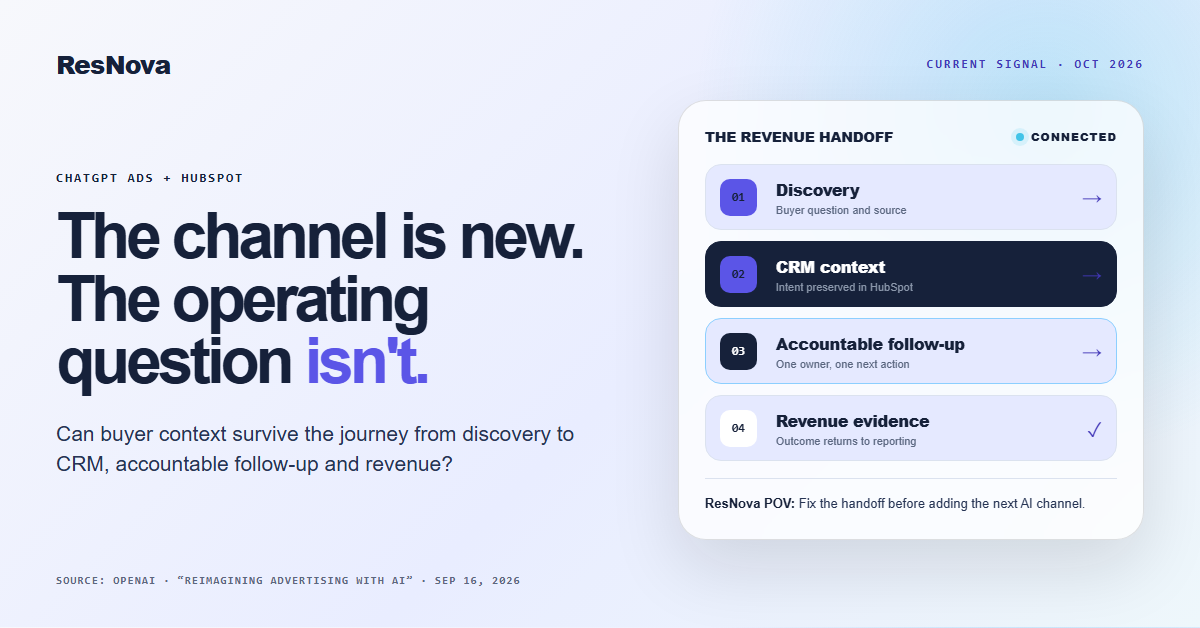
The short answer: Treat AI assistants as a new buying surface, not a replacement for your growth system. Make your expertise easy to discover, keep the buyer's context intact when they convert, assign a real owner and measure the path to a qualified conversation. Do not add another AI channel while the handoff from marketing to sales is still unreliable.
This week's signal is bigger than a new feature release. OpenAI announced advertising experiences that can begin a conversation with a sponsored business agent and integrations that bring ChatGPT Ads into HubSpot and Shopify. Google is expanding conversational discovery, AI-assisted ads and agentic commerce. HubSpot is making current CRM context the foundation for its AI tools.
Availability varies by product, account and market. The strategic implication is still clear: buyers can now research, compare and act inside AI-assisted experiences before they ever navigate a traditional website journey.
What changed?
OpenAI introduced Sponsored Agents and new ChatGPT Ads workflows on September 16, 2026. Its HubSpot integration is designed to bring campaign work and reporting closer to the CRM. That creates a shorter path between an AI-assisted discovery moment and the systems a revenue team already uses.
Google continues to expand AI Mode and AI-powered commercial experiences. Its May Search announcement described AI Mode as a global, conversational search surface, while subsequent advertising updates introduced AI explainers, business agents for leads and new measurement tools across Google Ads and Analytics.
HubSpot's Fall 2026 release reinforces the same direction from inside the CRM: AI performance depends on reliable business, customer and team context. The tools are changing, but the operating requirement is familiar. Useful automation needs accurate information, defined ownership and a measurable outcome.
Answer the buyer's real question clearly.
Carry source and intent into the CRM.
Assign a person and a next action.
Connect activity to pipeline and revenue.
What does this mean for a growing business?
Your website must answer questions, not merely list services. AI search and conversational ad experiences work from the information they can understand. Specific service definitions, comparison pages, buyer FAQs, expert judgment, accurate business details and strong internal links make the company easier to evaluate.
Your CRM becomes part of the marketing product. If source, service interest, company context, consent and conversation history arrive incomplete, the AI layer has little trustworthy context to use. More automation then creates faster confusion.
The conversion path must survive outside the homepage. A buyer may first encounter the business in an AI answer, a sponsored agent, a company post, a map result or a shared article. Every entry point needs a relevant next step and consistent attribution.
Human accountability matters more as automation expands. AI can summarize, route and suggest. A real owner still needs to decide whether the inquiry is qualified, what promise can be made and what should happen next.
Do not rush into every new AI ad product.
A new surface is not automatically a good channel. Before spending, verify that the audience is present, the offer is clear, the destination works, consent is handled correctly and the business can connect cost to qualified movement.
Start with a controlled test only after the foundation is ready. Define one audience, one offer, one conversion path and one revenue question. Compare qualified conversations and opportunities, not just clicks, chats or generated leads.
A practical 30-day response
- Audit the questions buyers ask: identify the ten questions that appear before a purchase across search, sales calls and CRM notes.
- Strengthen the owned answers: improve the relevant service, industry and comparison pages with direct answers, real expertise and an appropriate next step.
- Repair the handoff: preserve source, campaign, service interest and consent from the conversion point into the CRM.
- Define ownership: assign response expectations and escalation rules for forms, bookings and qualified replies.
- Build a channel test brief: document the audience, message, landing experience, safety controls and success metric before activating a new AI advertising surface.
- Review revenue evidence: assess meetings, opportunities and customers influenced by the test before expanding it.
The ResNova point of view
AI is compressing the distance between a buyer's question and a commercial action. That rewards businesses with clear expertise and connected systems. It punishes businesses that treat content, advertising, CRM and sales follow-up as separate projects.
The priority is not to look more automated. It is to make the company easier to understand, easier to trust and easier to buy from while preserving enough evidence to know what created the opportunity.
Use ResNova's Marketing System Assessment to find the first break in the path, or explore marketing operations and revenue intelligence when discovery, CRM and follow-up are disconnected.
Frequently asked questions
Direct answers for the next decision.
What is an AI buying surface?
An AI buying surface is an experience where a buyer can research, compare, ask questions or take a commercial next step inside an AI-assisted search, advertising, commerce or agent experience. Availability and capabilities vary by platform and market.
Should a small business advertise in ChatGPT or Google AI Mode now?
Not automatically. First verify audience fit, offer clarity, conversion tracking, CRM routing, consent and sales follow-up. Use a controlled test only when qualified conversations and revenue outcomes can be measured.
Does a business need special AI schema to appear in AI search?
No special AI schema is guaranteed to create visibility. Use supported structured data where it accurately describes the page, and focus on crawlable expert content, technical accessibility, entity consistency and trustworthy evidence.
What should be stored in the CRM from an AI-assisted lead?
Preserve the verified source and campaign, landing or conversation context, service interest, consent status, company and role information when known, assigned owner, next action and eventual opportunity or customer outcome.
Sources and further reading
Put the framework to work
Find the constraint in your growth system.
ResNova can diagnose the current path, set the priorities and build the strategy, execution and infrastructure required to improve it.
Book a Growth Strategy Call ↗