
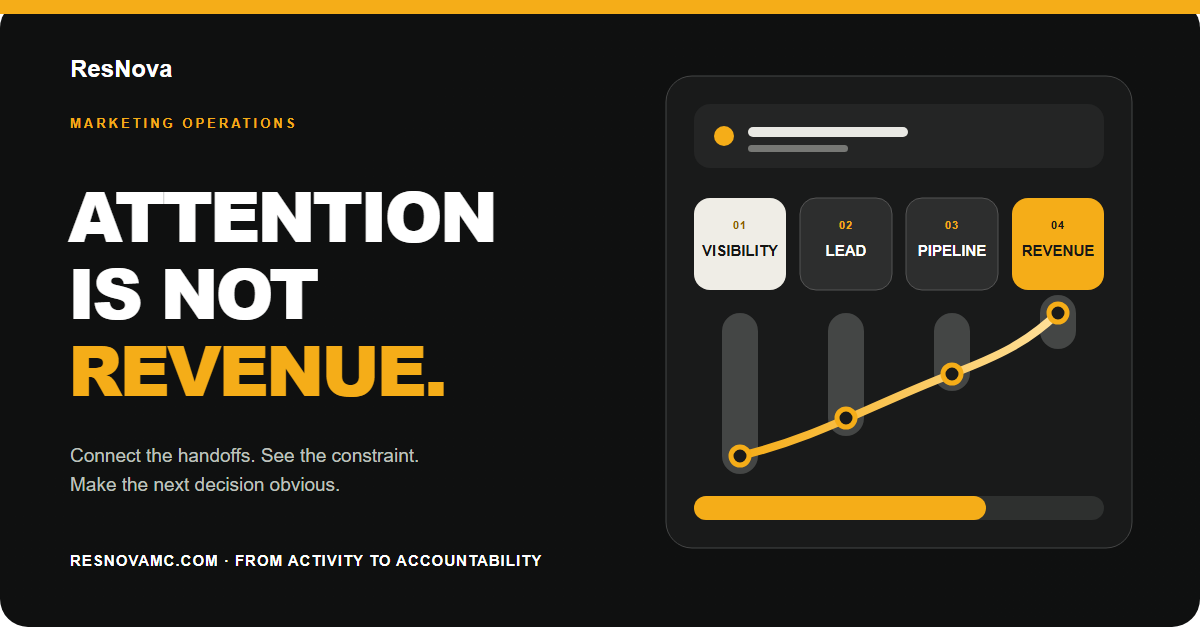
The short answer: Before buying more leads, verify that one real inquiry can move cleanly from source to landing page, form or call, CRM record, assigned owner, timely follow-up, qualified opportunity and revenue outcome. If any step is missing, unclear or unmeasured, fix that constraint before increasing volume.
A marketing operations audit is not a software inventory. It is a practical test of whether the business can recognize, respond to and learn from demand. The most useful output is a short prioritized repair plan, not another dashboard.
Start with one real lead journey.
Choose a recent legitimate inquiry and reconstruct the path. Identify the original source and campaign, the page or call path, the information collected, the CRM record, the assigned owner, the first response, the sales outcome and any revenue attached to the opportunity.
Do not begin with aggregate charts. A single record often exposes the handoff problem faster: a missing source, duplicate contact, unassigned owner, delayed response, disconnected meeting or opportunity that never made it back to marketing.
Agree on what each lifecycle stage means.
Marketing and sales need one shared definition for subscriber, lead, marketing-qualified lead, sales-qualified lead, opportunity and customer. HubSpot distinguishes lifecycle stages from lead status: the lifecycle describes where a contact or company sits in the broader process, while lead status can describe the sales sub-stage.
Write the entry criteria for every stage in business language. “Qualified” should not mean that someone filled out a form. It should reflect fit, need and the next real sales action.
Source, intent and consent arrive intact.
The right owner receives the inquiry.
Sales records the next meaningful stage.
Outcome data improves the next decision.
Verify measurement at the point of conversion.
Confirm that the production site uses the correct analytics and tag-management properties. Test consent behavior, conversion events, referral handling, campaign parameters and cross-domain journeys when a scheduler or form uses another domain.
A button click is not the same as a completed form, booked meeting or qualified opportunity. Name events so the business can separate intent from completion. Keep personally identifiable information out of analytics platforms.
Check ownership and speed without inventing a benchmark.
Every high-intent inquiry needs a named owner, a defined response expectation and an escalation path. Measure your own response time and conversion by lead type. The correct standard depends on the buyer, urgency and sales process, but an inquiry should never wait because two teams assumed the other one owned it.
Review after-hours, weekend and out-of-territory paths. Automation can acknowledge and route an inquiry, but it should not pretend to be a human sales conversation.
Inspect the places where good demand leaks.
- Forms fail, ask unnecessary questions or create duplicate records.
- Calls are missed without a documented callback process.
- Meetings are booked but reminders, outcomes or next steps are missing.
- Qualified replies remain in an outreach platform instead of entering the CRM.
- Marketing consent and cold-outreach status are mixed together.
- Sales rejection reasons are stored in notes instead of usable fields.
- Opportunities and revenue are not associated with the original contact or company.
Connect cost to qualified movement, not raw volume.
Once the path is reliable, compare sources by qualified conversations, meetings, opportunities, customers and revenue. Raw traffic, clicks and lead counts still help diagnose the funnel, but they should not decide budget alone.
Preserve uncertainty. If attribution or revenue data is unavailable, label it unavailable rather than turning the missing value into zero. That protects the next decision from false precision.
Turn the audit into a 30-day repair plan.
- Fix the critical break: repair any failed form, scheduler, routing rule or missing owner.
- Standardize the data: define lifecycle stages, source rules and required qualification fields.
- Close the loop: connect meeting, opportunity and customer outcomes to the original demand source.
- Remove reporting noise: filter test traffic, duplicates and self-referrals only after the rules are verified.
- Choose one demand test: add volume only after the business can follow and evaluate the next lead.
The point is not to perfect every system before marketing. It is to make the core buyer path dependable enough that new demand can become a real conversation and the business can see what happened.
Use ResNova's Marketing System Assessment to identify the first constraint, or explore marketing operations and revenue intelligence when the gap is measurement, routing or reporting.
Frequently asked questions
Direct answers for the next decision.
What is included in a marketing operations audit?
A practical audit reviews the buyer path, analytics and consent, forms and calls, CRM data, lifecycle definitions, ownership, response process, pipeline associations, attribution and reporting. The scope should match the business model and current systems.
Should a company stop lead generation during the audit?
Not necessarily. Keep productive work running, but avoid scaling a channel when the team cannot reliably capture, route, qualify or measure its leads. Fix critical breaks first.
How often should the lead journey be tested?
Test after a form, scheduler, CRM, consent or routing change and review the full path on a recurring schedule. Use clearly marked test data and do not confuse test submissions with real leads.
What should the audit produce?
It should produce a prioritized repair plan with evidence, owners, dates, tests and success criteria. A tool list or dashboard without clear actions is not enough.
Sources and further reading
Put the framework to work
Find the constraint in your growth system.
ResNova can diagnose the current path, set the priorities and build the strategy, execution and infrastructure required to improve it.
Book a Growth Strategy Call ↗