
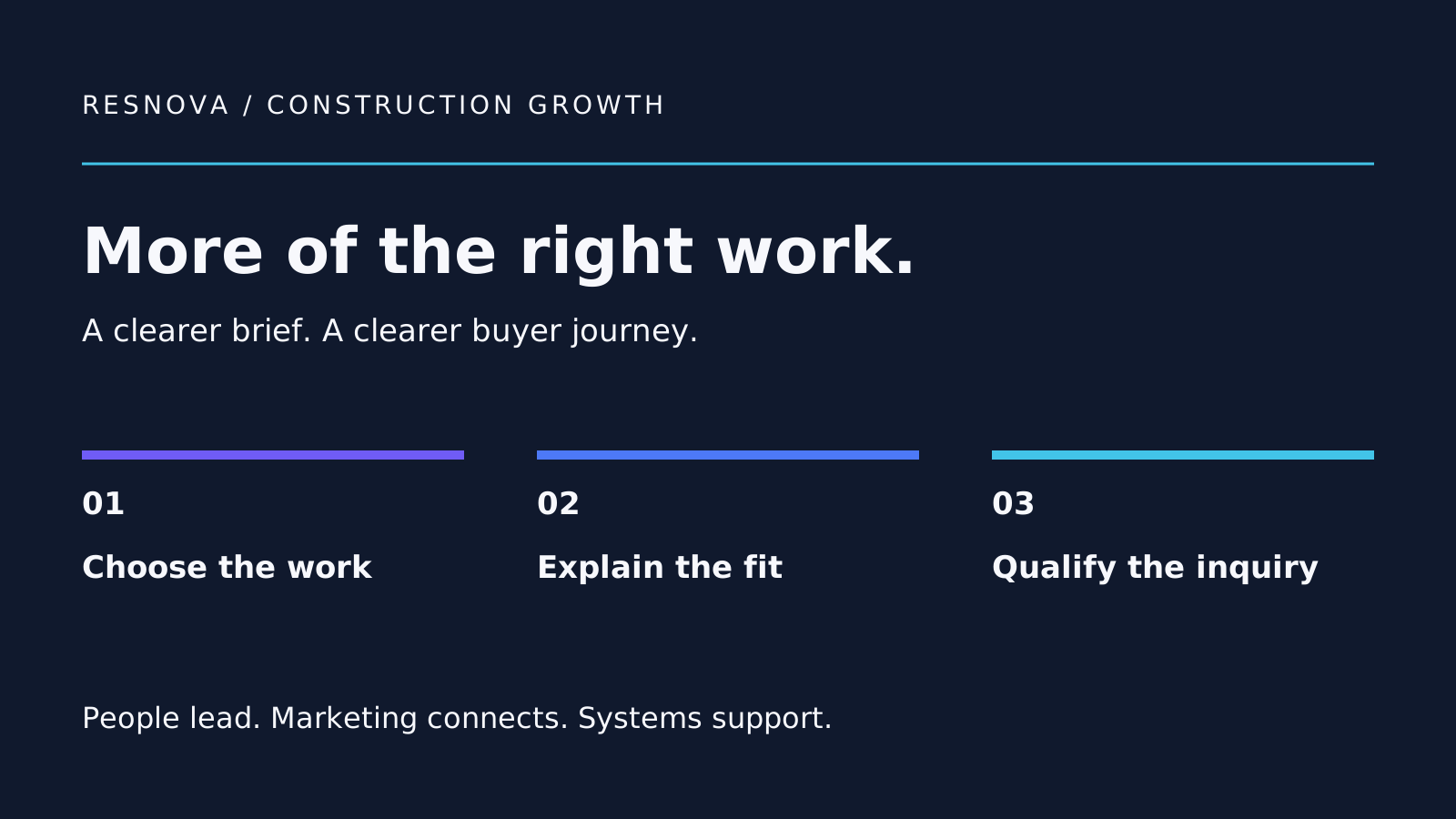
The short answer: Contractor marketing should start with the work the owner wants and the team can deliver, not a target number of leads. Define job fit with operations and estimating, make that fit clear on the website, and measure how inquiries become suitable opportunities. Marketing leadership connects these decisions; software does not make them for the business.
Start with the next job you would actually want to win
A busy estimator can spend a day answering inquiries without finding one project worth pursuing. That does not automatically mean the website needs more traffic. The business may be attracting requests outside its service area, work below its practical project size, or jobs that require crews and capabilities it does not have available.
Begin with a conversation between the owner, operations lead and estimator. Pick one type of work to prioritize. Use completed-job records and the team's experience rather than assuming that the biggest contract or highest inquiry count represents the best opportunity. An accountant or financial adviser should validate cost and margin assumptions; a marketing report is not a substitute for job costing.
Write a job-fit brief before changing a channel
ResNova recommends a short working brief with five decisions. This is a planning tool, not an industry benchmark or a guarantee of profitable work.
- Work: Which service or project type should the team pursue, and which requests should it decline or refer elsewhere?
- Buyer: Who initiates the inquiry, who evaluates contractors, and who approves the project?
- Constraints: What location, timing, project scope and crew availability make the job realistic?
- Evidence: Which genuine project examples, capabilities and references can the company show with permission?
- Owner: Who decides whether the inquiry fits and what happens next?
Keep the brief specific enough to use. “Commercial projects in our service area that need our stated specialty” is more helpful than “companies that want quality.” Do not publish confidential margins, customer records or internal capacity details simply because they informed the decision.
Help the buyer recognize the fit before calling
Compare that brief with the page a prospective customer actually lands on. Can they understand the work you do, the area you serve and the next step? If the page says “we do everything,” a buyer cannot easily tell when to choose you. List the real scope and explain the process in the words an owner, facility manager or general contractor would use.
Choose one relevant project example rather than a large gallery without context. Explain the problem, your role and the constraints you worked within. Only include outcomes that can be substantiated and published. A precise account of the work is more useful than an unsupported claim to be the area's leading contractor.
For a distinct service, connect its explanation to a clear inquiry route. Do not create a near-identical page for every town or project phrase. Improve the strongest relevant page first. Our construction marketing approach connects positioning with website, search and pursuit support rather than treating them as separate jobs.
Ask enough to route the request, not enough to lose it
A first inquiry is not a full estimating package. Consider asking for the service needed, project location, broad timing and a short description. If a budget range is necessary to establish fit, explain why and avoid implying that an initial answer is a binding quotation. Do not require a long form simply because the CRM supports more fields.
Give the request to a named person with a backup. That person confirms what the customer needs, checks the business's actual availability and agrees the next step. An automated acknowledgement can confirm receipt; it cannot establish that the job is suitable or that an estimator has accepted responsibility. The follow-up process needs people as well as a working system.
An illustrative decision, not a client result
Suppose a specialty contractor wants more planned commercial work but its website mainly describes urgent residential repairs. The first experiment would be to clarify the relevant commercial service page and route those inquiries to the right estimator, not immediately increase every channel's volume.
The owner supplies the actual service boundaries. Operations confirms capacity. Marketing translates the brief into useful buyer information. The estimator records why each inquiry did or did not fit. No uplift, revenue or conversion result is implied by this example; those outcomes require observation.
Measure qualified movement and review the misses
Keep inquiry counts separate from qualified conversations, estimating opportunities, proposals and won work. Record reasons for poor fit, such as location, scope, timing or unavailable capability. Review those reasons with the people answering calls. A decline in irrelevant inquiries can be useful even if total volume falls, but only judge it alongside suitable opportunities and capacity.
Use a defined observation period appropriate to the buying cycle and change one meaningful hypothesis at a time. If volume is small, describe individual patterns honestly rather than declaring statistical proof. Preserve original discovery source and any customer-reported source separately; an unexplained direct visit is not evidence of an AI recommendation.
Put one person in charge of the connection
The U.S. Small Business Administration's planning guidance connects customer research, market segments and the way a sale happens. The job-fit brief above applies that principle to a contractor's day-to-day decisions; it is ResNova's framework, not an SBA-endorsed method.
People must decide what work to pursue, listen to buyers and coordinate delivery. AI can help organize approved notes or draft copy for review, but it cannot replace that commercial judgment or accountability. ResNova provides fractional CMO leadership and practical execution to keep the work connected. Start with the Marketing System Assessment if you need to identify where your website, follow-up or measurement is breaking down.
Frequently asked questions
Direct answers for the next decision.
Should contractors optimize for more leads?
Not in isolation. Define suitable work with the owner, operations and estimating team, then measure qualified conversations and opportunities alongside delivery capacity.
Can marketing determine which jobs are profitable?
Marketing can use verified job-fit criteria, but accounting and operations must validate costs, margins and capacity. Lead volume alone cannot establish job profitability.
Does this require more advertising?
No. The first improvement may be clearer service information, better routing or more useful qualification. Choose distribution only after the buyer and job-fit decisions are clear.
Sources and further reading
Put the framework to work
Find the constraint in your growth system.
ResNova can diagnose the current path, set the priorities and build the strategy, execution and infrastructure required to improve it.
Book a Growth Strategy Call ↗